State Space Model
If we interpret a dynamical system as a state space model we can think of continous functions
, the state transition function and
a function that observes the current state and returns an Observation.
- → external factors
- → state
- → observations
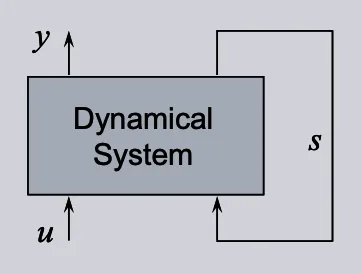
If experiences some kind of shock, then this will have the possibility to first propagate a few times through the network via before it becomes visible in . In the original Feed-forward Neural Network it would directly affect the outputs.
RNN
One can model a State Space Model using RNNs in two ways:
When there is only a small timespan between individual time steps, then the two approaches will be quite similar.