Propositional Logic as Set Description Language
Used for the Semantic Web.
Let be given by the following grammar for concepts:
So we have:
- atomics
- Concept intersection (and)
- concept complement (negation)
- concept union (or)
- concept subsumption (implication)
- concept equality (equivalence)
We can use all of our propositional identities that we already proved for Propositional Logic:
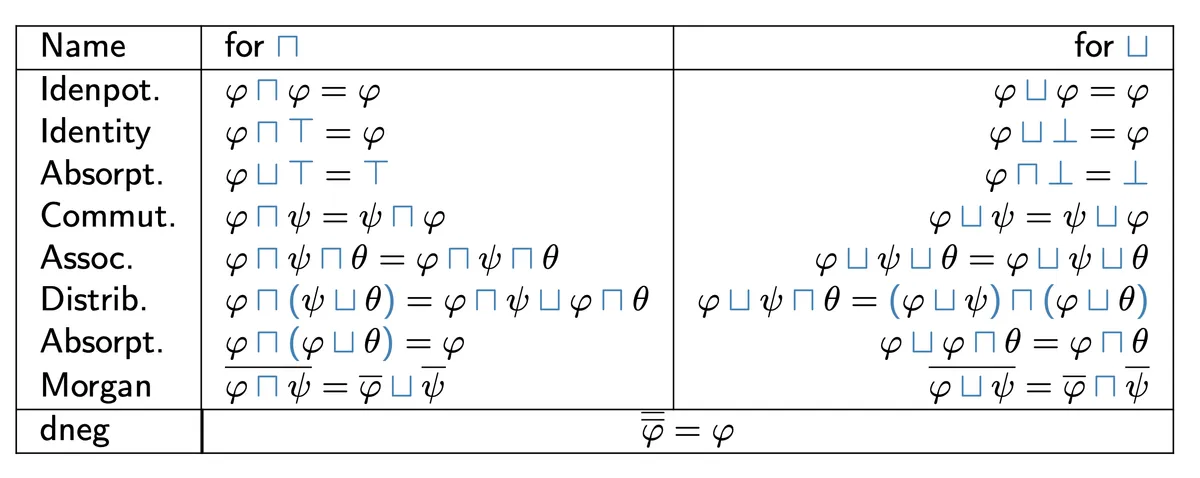
So we can actually compute with these.
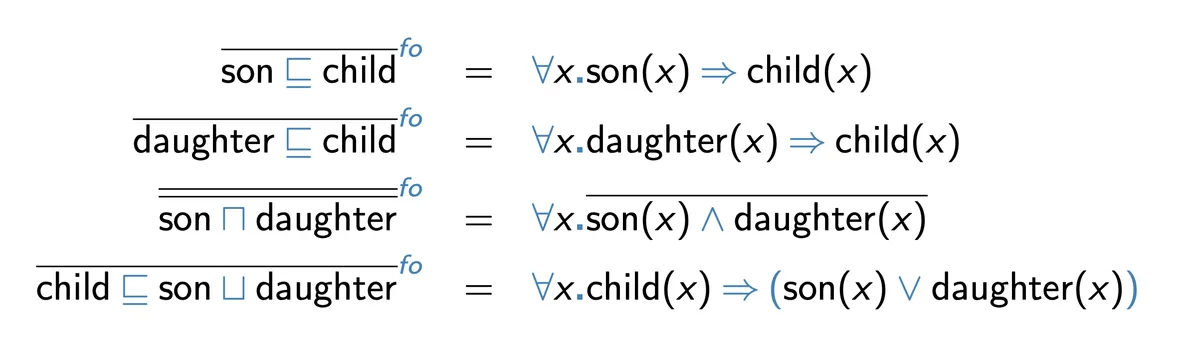
And we are able to translate back to Propositional Logic and then over to First-Order Predicate Logic:
→ Translation into First-Order Predicate Logic
Examples for this