Left-Sided Gauß Test
Also known as the buyers perspective. This test is used to accept if the Test Statistic attains values typical for (in this case large values).
Test Decision (Accept if)
Confidence Interval
Errors
The Type 1 Error is also called "embarrassing error" which we want to minimize:
The Type 2 Error can get large as it would be ok:
Both errors depend on the that has been chosen or found from an experiment.
Power Function
The Power Function is:
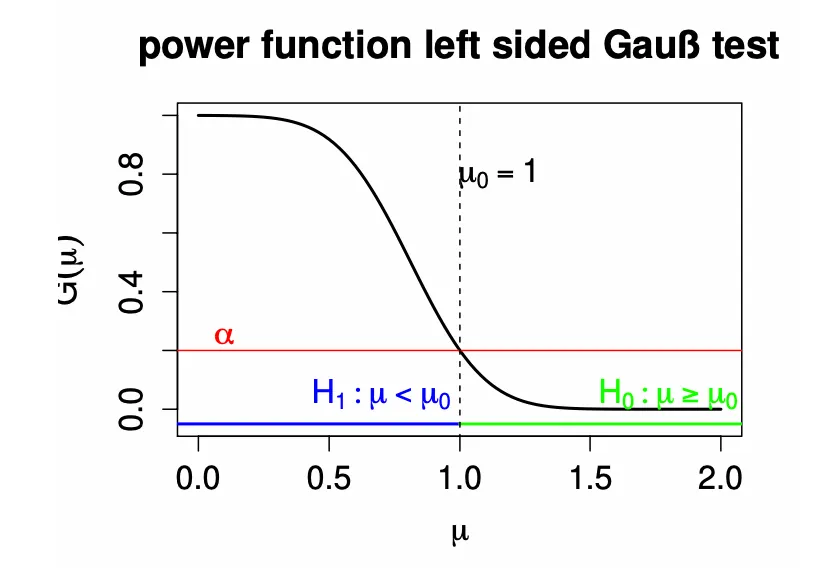
One can see that large values for correspond to small values of the Power Function and thus correspond to small probability for Type 1 Error.
On the other hand small corresponds to high power and therefor small probability for Type 2 Error.
Also you can tell that the power is quite low when we get near on the side of the graph. This corresponds with a hight Type 2 Error.
You can try to get it to look like a 1-0 jump by increasing the sample size. Power will get arbitrarily large (also see Planning Test Size)
This test can also be done from the sellers perspective → Right-Sided Gauß Test.